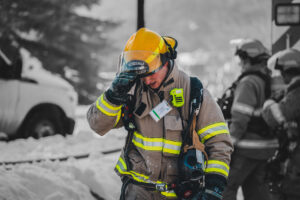
Research shows that 23.2% of PSP report clinically significant symptoms of PTSD but many have difficulties accessing care.
The PSP PTSD Course was designed to be helpful for PSP who have mental health concerns who are looking for a new way to access services or are faced with barriers for accessing care such as:
The therapist-guided PSP PTSD Course was originally developed at Macquarie University in Australia and was then adapted to meet the needs of PSP by the PSPNET team at the University of Regina. This course has shown success as a treatment for those with symptoms of posttraumatic stress disorder.
The PSP PTSD Course teaches evidence-based information and skills specifically for Canadian first responders and other public safety personnel (PSP) seeking to self-manage their symptoms of posttraumatic stress. There are 5 main lessons, each presented online via slideshows and downloadable guides, that we recommend completing over one or two weeks each. Be sure to check out the additional resources for more information on topics like anger, communication, and worry!
The therapist-guided PSP PTSD Course is designed to take 8-10. We recommend scheduling at least 1 hour to review each lesson content and, following, 1-2 weeks to reflect on and implement changes. Keep in mind that all course materials are accessible and downloadable for up to 1 year after enrollment!
The PSP PTSD Course is therapist-assisted. During the week, clients can send questions or comments to their assigned therapist though a secure online email system. Therapists check the website, review client progress on the course, and responds to emails once or twice a week. Most contact with the therapist is through secure emails, but sometimes therapists contact clients by phone. The amount of therapist support will depend on the needs of each client. Therapist support typically starts with 8 weeks and can be extended up to 16 weeks.
Therapists have graduate training in psychology or social work with specialized training in ICBT and PSP. Sometimes graduate students provide treatment under the close supervision of a registered mental health care provider.
Your participation is confidential. There are, however, some circumstances when we may need to break confidentiality, such as when there is:
PSPNET is a research facility. As such, when your information is used for research and scholarly purposes, we de-identify the information used for these purposes. This means that your information will only ever be analyzed and presented in a way such that you are not identifiable.
Throughout treatment (once per week) and then at 8, 16, and 26 weeks after starting treatment, we ask clients to complete questionnaires to help us evaluate the PSP PTSD Course. The number of questionnaires varies. Some weeks it takes less than 5 minutes to respond to questions and other weeks it may take about 20-30 minutes. This feedback is reviewed by the research team (without client identity attached) to help us understand how to improve the course. These questionnaires do not take very long but provide us with important information on your progress and the outcomes of ICBT.
The PSP PTSD Course is for PSP, including, but not necessarily limited to, public safety communications officials (e.g., call centre operators/dispatchers), correctional workers and officers, firefighters, paramedics, border security personnel, and police officers.
Specifically, the course is for PSP:
This course is not recommended if you have severe problems with alcohol or drugs, mania, psychosis, or are at high risk of suicide.
The therapist-guided PSP PTSD Course is offered in French. Please click here for details.
Our team is funded until 2028 and are actively working on a sustainability plan to expand PSPNET beyond 2028.
Please contact 306-337-7233 (SAFE) or email pspnet@uregina.ca.